The Big Read: Power, fame and fortune - a glimpse into Singapore’s lucrative YouTube industry
Advertising
Singapore
The Large Read: Ability, fame and fortune - a glimpse into Singapore's lucrative YouTube industry
Several homegrown YouTubers have managed to build thriving businesses with 1000000-dollar revenues . Simply the success of summit YouTubers has draw scrutiny over their content and less savoury aspects of the industry.
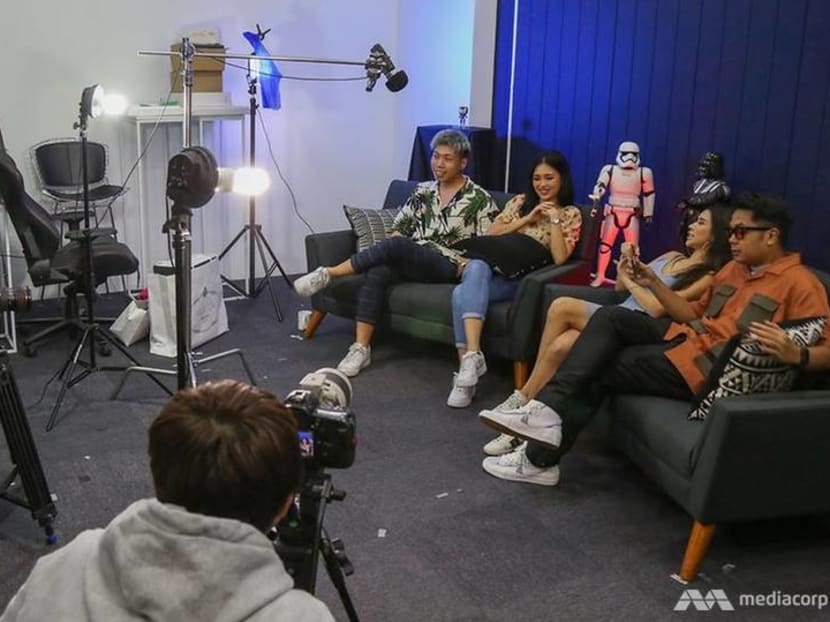
Mr Johnathan Chua (quaternary from correct), on set during a filming session for one of the episodes of the online talk show, Real Talk. (Photo: TODAY/Najeer Yusof)
13 Jan 2022 06:39AM (Updated: 13 Jan 2022 06:40AM)
SINGAPORE: With her pilus tightly pulled back in a ponytail, Rui looks like a typical 15-year-old with a serenity and studious demeanour - not quite what ane would await of a YouTube personality.
In nearly xv months, Rui, who declined to have her pictures taken or her full name published, has attracted almost 17,000 subscribers to her "spudstudy" channel.
Then far, she has put up 29 videos showing her putting together her report notes, tidying up her desk-bound, giving tips on how to accept ameliorate handwriting, as well as her travel vlogs, amidst other things - all without showing her face up.
One of her offset few videos, which she put upwards during the December holidays in 2018, racked up 400,000 views. The three-minute video titled "twenty-four hour period in my life : holiday edition" shows her going about routine activities such as taking intendance of her pet republic of guinea pigs and preparing her meals.
Requests for endorsement are already trickling in, from as far away every bit the United Kingdom (UK).
The first asking came from a tuition centre in the UK, while the 2d was from a video editing website. She did non take up the beginning one every bit she suspects that it is a scam while she turned down the other every bit the company wanted her to reveal her face.
She is currently talking to a business firm which wants her to mention a PDF document converter in one of her videos in return for U.s.$70 (Southward$94.50). In the concurrently, she has earned a couple of hundred dollars from AdSense, a program run by Google that allows advertisements to exist run on YouTube videos.
Despite her modest success on YouTube, Rui said she has no interest in trying to carve out a career by making videos, like what many YouTubers aspire to.
Speaking to usa at a buffet after school before this calendar week, she said her interest lies in science. "YouTube is a place where I relax during study breaks, become views and have fun, but I don't take it equally a career," she added.
Rui is earning peanuts compared to the eye-popping amounts that bona fide YouTube stars overseas likewise as in Singapore brand. But every YouTuber has to start somewhere.
READ: 8-twelvemonth-one-time is highest-paid YouTuber, earns The states$26 million a year
READ: 5 facts near Ryan Kaji - the 8-year-onetime minting it on YouTube
Ryan Kaji, who was born in Texas in the Usa, started unboxing toys on YouTube when he was just three.
Like Rui, Ryan started out with elementary videos - his starting time shows him playing with Lego bricks.
V years on, Ryan is earning millions.
In fact, he was named the highest paid YouTube star in Forbes' listing released last month, having earned The states$26 million last twelvemonth reviewing toys.
READ: Commentary: So your child wants to exist a YouTube star?
In second spot was the five-man sports crew, known equally Dude Perfect, which specialises in intricate trick shots. They made United states$20 million.
Rounding upwards the top three was Russian-American Anastasia Radzinskaya, five. She earned US$18 1000000 with videos that mainly characteristic her playing with her dad, according to Forbes. She now works with toy and food brands.
Singapore'southward biggest YouTube stars are not in the same stratosphere simply they are doing not too badly themselves.
At that place is piffling publicly available information about the YouTube manufacture in Singapore, except that the hours of content uploaded from YouTube channels here increased by over fifty per cent between 2022 and final year.
Nevertheless, Mr Tan Jianhao, 26, is regarded equally Singapore's summit YouTuber with 3.8 1000000 subscribers to his channel. The chief executive officer and founder of Titan Digital Media reportedly earns a half-dozen-figure sum annually although industry observers believe the amount to be higher.
Some other major thespian, Night Owl Cinematics (NOC) said their annual revenue is a seven-figure amount.
OUT OF THE Chamber, INTO THE BIG Fourth dimension
Official figures on YouTube'south earnings are not available, although estimates for 2022 ranged between United states of america$xvi billion and US$25 billion. As such, the size of the YouTube industry in Singapore is a mystery equally well.
But while at that place was the perception just five years ago that YouTubers should go a real job, several homegrown YouTubers have managed to break out of their sleeping accommodation workspaces to build thriving businesses with million-dollar revenues and dozens of employees.
Having built a brand on YouTube, many of them have established presence on other social media platforms too.
Co-ordinate to industry players, the "Big 4" of Singapore's YouTube industry are Titan Digital Media, NOC, Wah!Banana, and Clicknetwork.

Mostly run by millennials in the tardily 20s or early on 30s, these channels take hit the big time.
Together, they produce most of the one-act sketches, vlogs, and lifestyle videos that many young Singaporeans are glued to.
They are getting a big chunk of advertising and marketing budgets as well — both from government agencies and private companies, with quotations of almost S$30,000 or more for a branded video.
Clients are turning to them, instead of traditional product houses as the YouTubers offer quick turnarounds and "guaranteed" views.
Among the Big Four, Mr Tan Jianhao leads the pack, charging S$38,000 for branded content and Due south$20,000 for a vlog in 2022 when he had 1.iv million subscribers on YouTube, according to his June 2022 rate carte du jour.
Today, with nearly four one thousand thousand subscribers, it is estimated that Mr Tan Jianhao is charging about S$50,000 for a video on YouTube.
He did non answer to our query on his latest rates, but it could exist seen from his September 2022 Instagram rate card that his rates had more than doubled in 15 months.
With 581,000 Instagram followers in September 2019, he charged S$4,400 per photo post and S$10,000 per video post, up from South$1,800 and S$4,500 respectively in June 2018.
The September 2022 charge per unit menu besides showed that Mr Tan Jianhao'due south five-yr-erstwhile dog, a Pomeranian called BunCha, commanded rates of Southward$2,500 per video and S$1,200 per photo on Instagram. BunCha's account, babybuncha, currently has about 132,000 followers.
Such rates for Singapore's top YouTubers are by no ways scaring clients off.
NOC co-founder Sylvia Chan, 32, said she has to be more than selective with clients equally her firm'due south YouTube channel - which has about 967,000 subscribers - receives 50 to 150 enquiries a week.
The channel'southward median per-video income ranges between Southward$30,000 and S$twoscore,000, said Ms Chan who runs the business with her married man, Ryan Tan, 31.
However, Ms Chan said their business expenses including manpower and equipment costs are substantial, running into the millions.
FEW SAW IT COMING
When they first started their channel in 2011, niggling did they know how big the industry would become.
At that time, the world'southward almost-subscribed YouTuber, PewDiePie, had fewer than 60,000 subscribers and Ryan, the height earning YouTube star globally, was not fifty-fifty born yet.
"There was no money in this industry," said Ms Chan. "There were a couple of years where I only earned a few 1000 dollars a twelvemonth. A lot of people would have given up by then, but for us, I thought equally long as we are not that poor … nosotros were not in debt, and you are doing something that you beloved, it is okay."
READ: Commentary: It looks glamorous and fun, but most social media influencers are like unpaid interns
Co-ordinate to the YouTubers, the marketing dollars here started pouring in about 3 years agone.
For NOC, 2022 was a standout year where its revenue grew five to 10 times, said Ms Chan.
"I started … to deconstruct this business organisation … so that we could come across for ourselves the avenues where we need to be more than professional in and areas that we need to study a lot more on," she said.
The university dropout - who was reading economics and sociology at the University of London (Singapore) - and her married man, a former restaurateur, started taking a more active arroyo towards growing NOC'southward business concern from around 2015.
"We researched. Nosotros tried new things," she said. "You beginning to realise that this is not a joke anymore… It (became) a legitimate business organisation."
Now, NOC has nearly 40 people on its payroll, 25 of whom are total-fourth dimension employees.

Over at Wah!Banana, which has more than than 1 million subscribers, co-founder and producer Xiong Lingyi said the channel's revenue grew past 50 per cent final yr, and its clientele has grown across consumer appurtenances companies.
It now hires vii total-time staff and engages about a dozen talents.
Ms Xiong, 31, said: "We are not known for having keen production value, but we are very, very fast."
Noting that her aqueduct tin produce branded content as quickly as within two days, she added that it besides has "well-known talents".
She pointed out that there is "no shortage of coin" in the industry, given that many multinational corporations have their headquarters in Singapore.
"A lot of people hire us for the audience we take in this region," she said.
When Wah!Banana started out in 2012, 90 per cent of its audience were from Singapore. The proportion has dropped to less than 40 per cent today, as they gain audiences in Malaysia, Indonesia, Australia, India and the Philippines.
Based on our interviews with YouTubers, such a trend is common for many of them likewise.
Competition HOTS Up, AS RATES "NORMALISE"
The explosive growth of the lucrative YouTube manufacture has fatigued new players who were previously focused on other platforms.
They include TheSmartLocal and SGAG's Nubbad TV, which have nigh 264,000 and 72,300 subscribers respectively.
A relatively new entrant is a xxx-human content agency and media grouping, Grvty Media.
In 2018, it started producing a risque online talk show Existent Talk, which helped its Millennials of Singapore channel grow speedily.
The talk testify has featured topics such as how to "talk dirty" and the hosts had also shared how they lost their virginity.
A pop episode saw DJ and social media personality Jade Rasif, 25, letting her co-hosts try her chest milk.
Grvty Media co-founder Johnathan Chua, xxx, who is one of the four co-hosts of Real Talk, said clients become to them for their different appeal.
One of Existent Talk's latest and biggest clients is ride-hailing company Grab, which sponsored an episode where the co-hosts discussed their relationship with parents.
Towards the end of the unscripted episode, co-host Dew Francis, 28, who is besides Grvty's business evolution manager, introduced Grab into the give-and-take when he said that his female parent would get him to send her dwelling house, as she knew that two destinations could exist keyed into one trip guild.
At the cease of the bear witness, the co-hosts reveal that Grab had sponsored the episode.

Grvty media director Daniel Lim, 28, said more than clients are now aware of the power of soft sell.
At the same time, clients are becoming increasingly savvy.
"When we first started, there were a lot of cowboy players who were charging stupid amounts of money that was very, very hard to justify. There was no sense of normalisation," said Mr Chua, who was previously from social media agency Gushcloud.
Indeed, a YouTuber in his 20s who declined to be named, said that nearly five to vi years ago, he was shocked to be offered S$35,000 by his first customer to conceptualise and produce a series of vii 3- to 5-minute videos for a local brand. His aqueduct was merely a year quondam at that time and had about 10,000 subscribers.
"I idea it was S$5,000 for the whole project just when they say S$v,000 per video, I went like 'Huh!'," he said. Today, his aqueduct has more than 70,000 subscribers and he charges virtually Due south$ii,000 for a video.
READ: Commentary: What you get if y'all drink the Kool-Aid of social media marketing
Sex SELLS
The success of some of Singapore's summit YouTubers has recently been attracting criticism of their content.
Amongst other things, they have been criticised for beingness unoriginal and relying on listicles and eye candy - immature, bonny women wearing sexy outfits - to describe eyeballs.
In the middle of last year, content creator Sneaky Sushii sought to enter the manufacture with a splash, by putting up a video roasting some of Singapore's most prominent YouTubers.
The video titled "How not to exist a Singaporean YouTuber" was taken off YouTube due to a copyright claim by NOC over images of bikini-clad girls featured in Sneaky Sushii's clip which were taken from NOC's videos.
Mr Tan Jianhao too posted a series of Instagram stories in response. Defending his heavy use of listicles, he said: "This is YouTube. I am not going to spend weeks on a video then exit information technology there and hope nobody watches lol."
He added: "Viewers of the aqueduct have seen how much our content evolved over the years, and the listing is but simply a construction. And I don't program to change that anytime soon … Don't hate the thespian, detest the game."
READ: Commentary: YouTube stars make bad role models and it'due south all our fault
Asked about Sneaky Sushii's criticism on NOC's use of girls, Ms Chan said ane of the pictures featured was a screenshot from NOC'south travelogues to Phuket. She added, "If you lot get to Phuket, what do you want usa to wearable?"
Ms Chan pointed out that the top shows produced by NOC were "not the trashy talk shows" but "legit talk shows" - such as her recent interview with a tech entrepreneur on how he built his business.
Still, at least two YouTubers we spoke to admitted that the use of eye candy is a deliberate strategy in the industry to optimise view counts.
A YouTuber in his late 20s who declined to be named said he used the tactic one time on his channel, and managed to get more than 300,000 views.
"I was similar 'woah, that easy?' Of course, it was funny content as well, only girls are (half the boxing won) - the outset step of making a successful YouTube video in Singapore or anywhere else," he said.
Still, junior higher student Jamie Lynn, 17, who has stopped watching Singapore YouTubers even though she used to every bit a kid, said she is "disgusted and disturbed" by the use of sexualised images to draw viewers.
"It will breed a very predatory kind of culture ... It makes it look like information technology's okay to use women'southward bodies for clickbait and for boys to retrieve of girls like that," she said.
In general, she now finds that the comedy sketches past Singapore YouTubers are "too exaggerated" and the jokes "are not funny anymore".
THE Power Structure: EITHER YOU'RE IN OR You'RE OUT
A YouTuber in his late 20s besides offered some insights into another less savoury aspect of the industry – a toxic numbers game in which the person with the nigh subscribers plays "god", and a bureaucracy forms around others with the next biggest subscriber bases.
He said he wants to create his ain brand of comedy, but even as he gained a notable following, he deliberately chose non to be too closely associated with the in-group every bit he did not want to be embroiled in their politics couched equally a culture of "collaboration".
In his early days, he had thought that he should be part of the group and he did hang out with the "cool kids".
"The dynamics are such that if someone helped me before the concluding time and I forgot about them subsequently I got famous, they volition talk behind my back and say: 'So you are doing your ain thing now?'" he said. "There'southward the unsaid matter of how you amend pay your respects and kiss the band."
Co-ordinate to YouTubers interviewed, a well-known clique in the local scene comprises NOC, Mr Tan Jianhao and Mr Darryl Koshy (meliorate known as Dee Kosh).

In 2017, YouTuber-turned-thespian Noah Yap spoke out against this clique, after they posted a "Smash or Pass" video, in which they go through a list of other well-known influencers and declare if they would consider him or her attractive enough to slumber with.
In his vlog, Mr Yap said the YouTubers customs was thriving too much on each other's drama, and it became simply about how many followers a YouTuber has, and "who has the hottest girls (or) who has the biggest (breasts)".
Dee Kosh responded to claims of bullying thrown at him by other YouTubers. Amidst the examples cited was a video which Dee Kosh did in 2022 with boyfriend social media personality Munah Hirzi, where they fabricated fun of influencer and YouTube personality Nicole Choo after she published a volume.
Dee Kosh said he does not consider it to be bullying when he laughs "at the stupidity of another one of my peers".
"Information technology is true that in this twenty-four hours and age, you're gonna need to be conscientious and, in some sense, exist politically correct and responsible, fifty-fifty when information technology comes to comedy. But that is not me," he said.
"If y'all put yourself in the public eye and yous mess up, and people laugh about it, sadly, it's just what comes with y'all beingness in the public middle."
He added: "My one-act is a reflection of gild, of yous, fifty-fifty the bad parts nigh information technology, and if you yourself looking in the mirror tin can't accept what you run across, then of course you're gonna arraign the mirror for bullying you. So if you can't have the estrus, then why are you in the kitchen? Basically, loosen up."
Ms Chan from NOC described the customs as one "where people want each other to grow".
"We have been friends with the other YouTubers for many years. I believe that this is a very stiff customs … We are the pioneers and we kind of set this standard, so if you are non a customs thespian, and so we don't want to be friends with you," she said.
On the claims that the big players assist one another at the expense of others, Ms Chan said that such collaboration is simply a way by which close friends assistance each other to stay competitive.
"If a client is particularly rich, I'll say: 'You lot know what, bro? How about a video on Jianhao'due south (channel) too?' And the same matter he does for me and Dee Kosh," she said.
Mr Tan Jianhao did not respond to our asking for comment.
On whether such a civilization could be a detriment to smaller players hoping to break into the scene, Mr Marc Lefkowitz, head of creator and creative person development for YouTube's Asia-Pacific operations, reiterated that "anybody has an opportunity to be successful on YouTube on their own".
He pointed out that YouTube provides learning courses such as the YouTube Creator Academy or the Creator Insider aqueduct to level the playing field.
YouTube has created an "entirely new creative economy" and many successful creators accept gone on to found companies and create job opportunities for swain aspiring artistic minds in the community, Mr Lefkowitz said.
IS THE INCREASINGLY CROWDED SPACE Large ENOUGH?
Indeed, some YouTubers new to the scene said they by and large felt that at that place is enough space to flourish on their own terms.

Ms Brenda Tan, 24, started creating lifestyle videos on YouTube in 2016. She has never felt a need to conform to creating certain types of videos, such as comedies that have proven to exist successful.
"The number one comment I get from my audience and subscribers is that they enjoy how refreshing my content is because I'm just being myself and talking about things I similar, that makes sense to me in my life," she said. "I feel really proud of my content and motivated to make more of what I want to make without jumping on trends."
Other YouTubers too pointed out that they demand non restrict themselves to the Singapore market.
Ms Tiana Roy, 22, who runs lifestyle YouTube channel "heythisistiana", said she prefers engaging an overseas audience.
"I observe the YouTube scene in Singapore a bit 1-dimensional… I might also exercise what I like," she said.
Still, the industry is not for the faint-hearted. A sometime darling amongst the audience, TreePotatoes, which has 390,000 subscribers, might be calling it a mean solar day.
The aqueduct, which was launched in Nov 2022 only is inactive these days, had produced videos which in their own words, "explore all the quirkiness of life in Southward-east asia".
Ms Janice Chiang, 32, one of the personalities backside the channel, said their client enquiries, which used to come from government agencies and big firms, started tapering off two to three years ago.
So rather than focusing on producing branded content, it started exploring alternative sources of revenue by going into producing original content - at a fourth dimension when big names such as Netflix and HBO were growing such offerings.
"We decided that we better leap before the send starts sinking," said Ms Chiang, who is at present doing marketing and business development in the media manufacture.
"EVERY KID WANTS TO BE A YOUTUBE STAR"
As the manufacture continues to grow and evolve, many parents are becoming concerned near the influence that YouTubers have on their children.
In fact, it is common to hear kids saying they want to exist YouTube stars when they abound up.
Mr Steven Mun, 48, a customer service executive, has a 13-year-old daughter and a 14-yr-onetime son.
His daughter, Shernice, said she spends about four hours a mean solar day after schoolhouse watching videos on YouTube. His son, Sheldon, wants to be a YouTuber talking about video games.
Mr Mun noted that children these days no longer aspire to exist doctors or lawyers.
"We parents have a dream of what nosotros promise our kids to be only that doesn't mean they want to be. It'south better to let them cull their career paths and we as parents can guide them," he said. "I told (Sheldon) to get a job and do YouTube on the side. If his channel takes off, then he can do it full fourth dimension."
As for his girl, he constantly nags at her to manage her time better. Yet, he acknowledges that watching YouTube can be beneficial for his children if they use information technology "the right style".
He added that his children have learnt vocabulary from watching YouTube videos. "My son as well learnt entrepreneurship ideas from there. But of course there is always the other side of the coin," he said.
The darker side of social media platforms like YouTube is what Ms Lee Mui Kiaw, a 49-year-erstwhile ceremonious engineer, is worried about.
Ms Lee is the female parent of Rui, the YouTuber who has gained a post-obit for her videos on putting together study notes, amongst other seemingly mundane things.
The popularity of Rui's videos on YouTube had surprised her mother. "I did non expect that she volition take so many subscribers and views but I'm happy and proud that she did it on her own," Ms Lee said.
But she is worried that Rui might "autumn prey to criminals who pose every bit sponsors and advertisers".
"Luckily, she will hash out with us parents and I hope it works out well," she said.

Recent Searches
Trending Topics
Source: https://cnalifestyle.channelnewsasia.com/singapore/big-read-power-fame-and-fortune-glimpse-singapores-lucrative-youtube-industry-295301
0 Response to "The Big Read: Power, fame and fortune - a glimpse into Singapore’s lucrative YouTube industry"
Post a Comment