What Happens to Someones Debt When They Die
What happens to debt when you die?
Thinking nigh and dealing with the debts of a deceased person is non a cheery idea. But it's an of import subject field and considering information technology's rarely talked about, can exist easily misunderstood and lead to confusion well-nigh what happens to debt when you die, and who is ultimately responsible for information technology. So practise credit card debts die with you? And what happens to articulation debts? In this article we'll answer all that and more.
Who pays your debts when you die?
Your debts become the responsibility of your manor later yous die. The executor of your manor is the person(s) responsible for dealing with your will and estate later your decease. The executors or administrators are liable to pay Inheritance Tax on holding that forms part of the deceased'south estate, and will use your assets to pay off your debts.
Joint debts
If two or more people have taken out a loan in their names, in most situations the outstanding debt will pass in full to the surviving people who took out the loan.
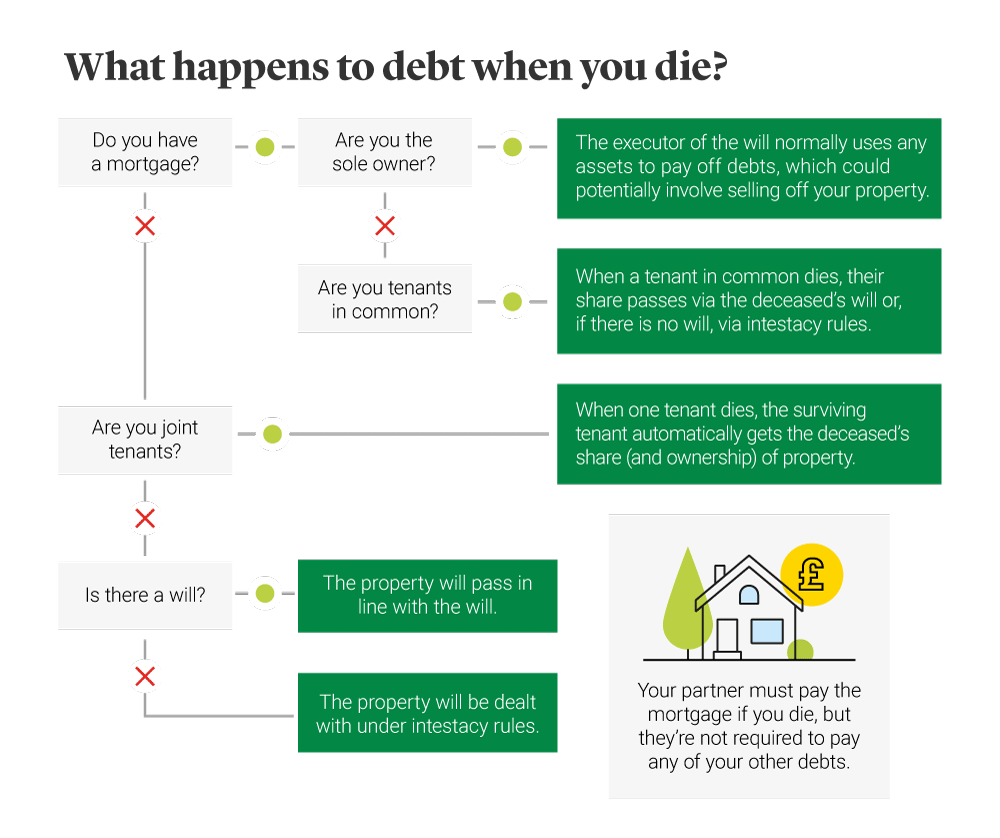
If at that place is a mortgage, and then your surviving spouse, registered ceremonious partner or co-habiting partner, for case, must pay that mortgage but is not required to pay any of your other debts.
If yous are joint tenants, your abode does not course part of your estate, except for the purposes of calculating Inheritance Tax. Following the decease of one tenant, the surviving tenant automatically gets the deceased'due south share (and ownership) of the articulation tenancy property.
If yous are the sole owner, then again the executor will usually utilize any assets to pay off debts. Depending on how much is owed, this could potentially involve selling off the property.
The situation is the same if you are joint owners nether tenancy in common; that is, the holding'south equity is endemic in defined shares by two people. After the death of a tenant in common, their share passes not automatically to the survivor (as with joint tenants) simply according to the deceased'south will or, if there is no will, via intestacy rules.
A joint mortgage and a joint current account with an overdraft are examples of articulation debt.
If there is no insurance
If yous don't have insurance in place, what happens to your debt when you die? The executor of your will should contact the creditors to make arrangements to pay off the debts, assuming they haven't already fabricated a merits on the estate. If there is no life policy to cover the mortgage and the beneficiaries named in the will or nether the rules of intestacy have no wish to obtain, or do not qualify for, a mortgage, then the property may be sold to cover the outstanding debt.
For joint debts:
- Y'all should check the terms of the loan
- Inquire the creditors to accept out your deceased partner's proper noun from the bills and transfer all future bills to your sole name.
- If you lot can't afford to pay each instalment in full, see if you can renegotiate the repayments to a lower amount, and to a schedule you can manage.
Are families responsible for debt later expiry?
Debt isn't inherited in the United kingdom, which means that family, friends or anyone else cannot go responsible for the individual debts of the deceased.
You lot're only responsible for the deceased person'due south debts if you lot had a articulation loan or agreement or provided a loan guarantee. So in short you aren't automatically responsible for a spouse's or registered ceremonious partner's debts. And while the Personal Representative is not personally liable for the debts of the deceased, those debts are likely to have to be paid from the manor of the deceased.
Exercise credit card debts dice with yous?
A mutual misconception is that any credit card debts are automatically written off. Instead, any individual debts must be paid using the coin the deceased has left behind. Only if there isn't enough money in the Estate may the debt be written off.
A personal credit carte with an outstanding unpaid balance is an instance of individual debt.
Undisclosed debts
Once all the debts post-obit a death are paid, the executor might find a debt they knew nothing about. A mode to avert this is to advertise in a local newspaper before y'all start arranging to pay the debts. This gives the deceased's creditors futurity forward with any claims.
You aren't nether a legal obligation to place a Deceased Estates Discover, just if you neglect to do and so, yous could put yourself at risk. This is considering if you distribute the Estate and a creditor and then comes forward, you could exist found personally responsible. You lot might therefore accept to pay the debt from your own pocket. A menses of at to the lowest degree two months should be allowed from the date of the advertisement for the submission of whatsoever potential claims on the manor.
How to bargain with debts every bit the executor
I of the tasks the executor may face after the death of a loved one is sorting out their debts and working out what still needs to exist paid. Every bit the Personal Representative, here are some of the steps you lot can take and issues to consider:
- Contact creditors and explain the situation, asking them to send a statement outlining annihilation still owed.
- Make certain that in the case of an individual debt, similar a credit card debt, the banking company immediately stops taking any scheduled Directly Debits from the deceased's bank account.
- Annotation that in the case of a articulation banking company account, the surviving partner becomes the sole owner of the account, and remains responsible for whatsoever debts.
- If it is a joint debt, then the name of the deceased can exist removed from the debt.
- With any luck, the deceased will accept put all the relevant documents together – including insurance policies – and volition have let someone know where they are or even included such details in their estate plan.
- Remember to check paper records, computers, retentiveness sticks, and cloud-based storage for digital versions of documents.
Once the Personal Representative of the volition has probate or grant of assistants, the money from the deceased'southward estate can be used to pay off any outstanding debts. If the money in the estate runs out before some debts are paid off, the estate is considered to be insolvent. If that applies, there is an society of priority to how the debts are paid. The payment of debts must be completed earlier the manor can be divided betwixt heirs.
Putting your life insurance in trust
Writing your policy nether trust is a legal arrangement which allows the possessor of a life policy (the settlor) to requite their policy to a trusted group of people (the trustees), who look later it. At some time in the future they pass it on to some people from a grouping that the settlor has decided (the beneficiaries). The trustees accept discretion about which of the beneficiaries to pass information technology on to, how much each will go, and when
Placing your policy under trust ensures a quicker payment, without the need for probate, and as the policy falls outside your estate it could help reduce your Inheritance Taxation liability (IHT).
How life insurance can secure your family unit's future
Planning for a futurity where yous're no longer effectually is not the nicest of topics, but the good news is that our life insurance policies can help brand matters easier.
For technical advice on writing your policies under trust, contact Legal & General today.
Find out more than most our range of life insurance policies.
Source: https://www.legalandgeneral.com/insurance/over-50-life-insurance/later-life-planning/what-happens-to-debt-when-you-die/
0 Response to "What Happens to Someones Debt When They Die"
Post a Comment